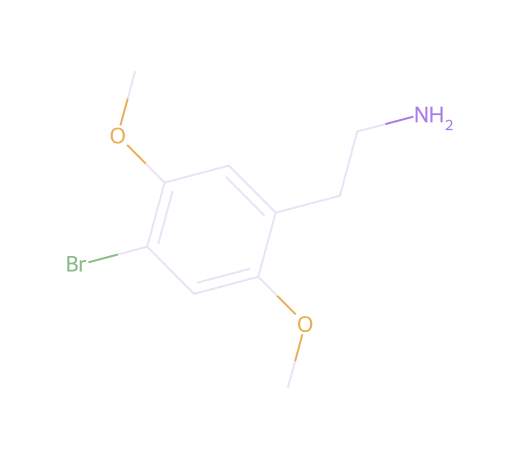
- Onset
- 20–45 min
- Duration
- 4–8 hr
- Route
- Oral · insufflated
- Forms
- Powder · tablet · capsule
- Legal
- Schedule I (US); illegal in most jurisdictions
The bridge compound
2C-B is a synthetic psychedelic in Alexander Shulgin's 2C-x family of phenethylamines. It is often described as a bridge: the bright visuals and geometric patterns of a psychedelic, plus the tactile warmth and sociability more typical of entactogens.
It is shorter than LSD and often clearer-headed than psilocybin at moderate doses. But its reputation for being easygoing is only partly earned. The dose-response curve is steep, and 2C-B becomes a very different drug as the milligrams rise.
From PiHKAL to the club
Shulgin first synthesized 2C-B in 1974 and documented it in PiHKAL. In the 1980s and early 1990s it was sold legally in some countries as an aphrodisiac under names like Nexus and Erox. It was briefly a legal alternative at a time when MDMA was still moving toward prohibition.
After MDMA was scheduled in 1985, 2C-B rose as an alternative in club and rave scenes. The United States classified it as Schedule I in 1995. Human clinical research remains thin, so most of what is known comes from observational studies and user reports.
A 5-HT2A agonist with a broader hand
2C-B is a 5-HT2A agonist, like the classical psychedelics, but its receptor profile is broader and less well characterized. That may explain the unusual mix of effects: visuals, possible entactogen-like warmth, and a mild stimulant edge.
In a small placebo-controlled trial comparing 2C-B to psilocybin, 2C-B produced less ego dissolution and cognitive impairment at equivalent doses, leading the authors to describe it as comparatively non-ego-threatening. That was one study at one dose; it does not mean high doses are gentle.
Bright, social, and dose-sensitive
At lower doses, 2C-B feels light and sociable. Colors brighten, surfaces shimmer, music feels richer, and touch becomes more pleasurable. The head is often clear enough to talk, dance, or be intimate.
At higher doses the visuals become more insistent and the body load increases. Nausea, anxiety, and a sense of being overwhelmed can appear. The experience is shorter than LSD, which can feel like a relief if things turn difficult, but the come-up can feel abrupt.
The peak usually arrives one and a half to two and a half hours in, with a gradual comedown over the next few hours. Sleep is usually possible by the end of the night.
Where you land matters
These ranges are for oral 2C-B. Insufflation is much stronger and more painful; a few milligrams make a large difference. Tap a band to see it.
The full 2C-B. Colorful visuals, warm body high, clear head, and a sociable edge. The dose curve steepens from here.
The dose curve is the danger
2C-B has a real overdose threshold, unlike psilocybin or LSD. High doses can cause severe agitation, hypertension, hyperthermia, and seizures. The difference between a light social dose and a heavy psychedelic dose is only a few milligrams.
Mis-selling is common. 2C-B is sometimes confused with or sold as other 2C-x compounds, NBOMes, or MDMA. "Tusi" or "pink cocaine" is usually not 2C-B at all; samples are typically random mixtures of MDMA, ketamine, caffeine, and food coloring.
Dangerous with lithium, tramadol, MAOIs, and stimulants. Avoid with a history of psychosis, seizure disorders, or cardiovascular disease. Never redose impatiently; the come-up can take up to an hour.
Weigh, test, wait
Three practices make 2C-B much safer.
- Weigh your dose. Eyeballing powder is reckless. A milligram scale is essential, and a small difference matters.
- Test your substance. Use Marquis and Mecke reagents at minimum. If it is sold as a pill or pink powder, be especially suspicious.
- Wait before redosing. The come-up can take forty-five to sixty minutes. Taking more because you do not feel it yet is how people end up in the emergency room.
Shulgin's club child
PiHKAL and the Nexus years
Shulgin's Phenethylamines I Have Known and Loved introduced 2C-B to the psychonaut world alongside dozens of related compounds. For a brief window it was sold openly as an aphrodisiac, giving it a reputation as a social, sensual drug that still colors how people think of it.
The rave and festival scene
After MDMA scheduling, 2C-B found a place in clubs and festivals. Its shorter duration and social glow made it attractive. But the same settings also produced overdoses when people misjudged doses or mixed it with alcohol and stimulants.
The tusi problem
In recent years, "tusi" or "pink cocaine" has become a nightlife staple in some cities. Despite the name, it is rarely 2C-B. The mismatch between reputation and contents is one of the clearest examples of why reagent testing and trusted sources matter.
[owner voice — a short, personal note on how to approach 2C-B.]
Sources
- Shulgin, A.T. & Shulgin, A. — PiHKAL: A Chemical Love Story (1991)
- González, D. et al. (2015). Acute effects of 2C-B on emotions. BioMed Research International.
- Erowid — 2C-B vault
- DanceSafe