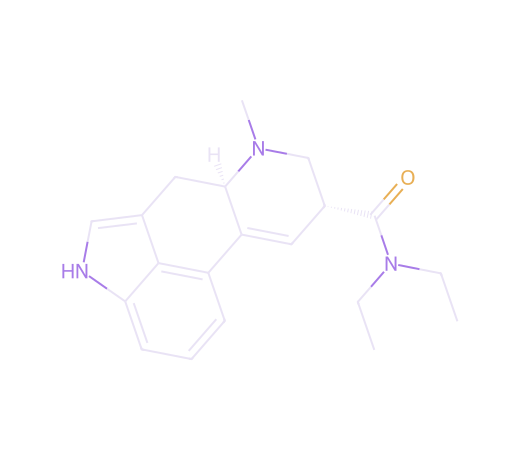
- Onset
- 20–60 min
- Duration
- 8–12 hr
- Route
- Oral · sublingual
- Forms
- Blotter · liquid · gel
- Legal
- Schedule I (US), illegal in most jurisdictions
Millionths of a gram
LSD is active at doses measured in millionths of a gram. A single gram holds roughly ten thousand of them, which makes it the most potent of the classic psychedelics by a wide margin.
It is a semi-synthetic lysergamide built from ergot, a fungus that grows on rye. Chemically it sits near the tryptamines and works on the same serotonin system. But the experience is its own animal: longer, brighter, and more relentlessly mental than anything else on this list.
Out of the lab
Albert Hofmann first made LSD at Sandoz in 1938 while looking for a circulatory stimulant, then set it aside for five years. In 1943 a trace absorbed through his skin pulled him into the unknown. A few days later he swallowed 250 micrograms on purpose and cycled home through a world gone liquid. April 19th is still marked as Bicycle Day.
For a while LSD lived a quiet life in psychiatry, and a less quiet one in the CIA's files. Then it found the culture. By the mid-1960s it had jumped the lab walls entirely, and what happened next reshaped a decade of music, art, and thought.
A lid that won't lift
LSD binds to the brain's 5-HT2A serotonin receptors, and unusually, a small flap of the receptor folds shut over the molecule once it is there. That partly explains why a single dose lasts most of a day.
With those receptors active, the default mode network quiets down, the brain's usual hierarchies loosen, and regions that rarely talk to each other start to. What sets LSD apart from psilocybin is not the receptor they share. It is the length of the ride, and the fast, lucid, thinking-forward quality of the headspace.
Long, bright, electric
The come-up is gradual. Twenty minutes to an hour of rising charge, a faint shimmer at the edges, the sense that someone is slowly turning a dial.
Then the plateau, which holds for hours: moving geometry, looping insight, feeling that swings wide, time stretched thin. People keep reaching for the same comparison. Where mushrooms feel like a forest, acid feels like a thunderstorm.
The descent is soft, but the whole arc runs eight to twelve hours, with an afterglow that can carry into the next day.
Where you land matters
LSD's range is wide, and every step up is a different experience. Tap a band to see it.
The full classic trip. Strong visuals, deep emotion, time stretched thin, the sense of seeing things freshly. Clear the day for it.
Safe body, demanding mind
Physically, LSD is one of the safest drugs known. There is no established lethal dose and no organ toxicity.
Its real dangers live in the mind and in the clock. The long window leaves plenty of room for anxiety to spiral, for judgment to slip, for one hard hour to feel endless. And the sharpest practical danger is not the LSD itself. It is whatever gets sold under its name.
Genuinely dangerous with a personal or family history of psychosis or schizophrenia. Carries a seizure risk alongside lithium, and behaves unpredictably with SSRIs.
Test, start low, clear the day
Three things make LSD safer, and the order matters.
- Test it. Research chemicals like the NBOMe series get sold on blotter as acid, and some can do real harm at the dose a single tab delivers. A drop of Ehrlich reagent turns purple with real LSD and does nothing to the impostors.
- Start low and wait. Blotter strength is a guess until it isn't, and the door only opens one way.
- Mind the set and setting. The window is long, so these carry more weight here than almost anywhere. Clear the day, choose your people, keep a sober sitter for the deep end.
The decade it colored
No molecule on this list left a bigger mark on culture, and it pulled music along with it.
The Acid Tests
A lot of it began with a bus. The novelist Ken Kesey and his Merry Pranksters threw the Acid Tests, freeform parties soaked in LSD, with a young house band first called the Warlocks and soon renamed the Grateful Dead. Their soundman was Owsley Stanley, an underground chemist whose acid was so pure and so widespread that his name became shorthand for quality. He bankrolled the Dead and helped build the towering sound system they played through.
The Summer of Love
By 1967 it had a capital. Thousands converged on the Haight-Ashbury district of San Francisco, and the music followed the chemistry. Jefferson Airplane put psychedelia on the radio. The Grateful Dead turned the trip into a way of playing, long and exploratory and never the same twice. Across the ocean the Beatles were doing it in the studio, where Revolver and then Sgt. Pepper's reached for sounds nobody had heard before. Brian Wilson chased something similar with the Beach Boys, and Pink Floyd formed around Syd Barrett, whose brilliance and whose unraveling both became part of the legend.
The prophets
The era had its evangelists. Timothy Leary, a Harvard psychologist turned preacher, handed it a slogan and a notoriety that got him branded the most dangerous man in America. When half a million people gathered at Woodstock in 1969, acid was part of the air, and so was one of the first harm-reduction systems for it: announcements from the stage about which batch to leave alone.
The comedown
Then came the comedown, cultural and chemical. The promise curdled, the law closed in, and by the early 1970s LSD was illegal almost everywhere. Serious research went dark for thirty years.
Myth, separated from fact
With the fame came the folklore, most of it false. There is no strychnine in acid. It does not hide in your spine for life. Flashbacks are real but rare, and nothing like the legend. And you cannot overdose to death the way the old warnings imply. Telling the genuine caution from the inherited fear is half of understanding it.
LSD asks for a kind of respect that is easy to skip when the whole dose fits on a scrap of paper the size of a fingernail. It is not a party favor, and the people who get the most from it tend to treat it the least casually.
Give it the day it demands. Decide why you are going in before you go, because twelve hours is a long time to spend with a question you did not choose. Bring less certainty than you think you need, and more water than you think you'll drink.
The molecule does not make meaning for you. It only turns up the lights. What you do with what you see is the real work, and it starts the morning after.
Sources
- Hofmann, A. — LSD: My Problem Child (1980)
- Nichols, D.E. (2016). Psychedelics. Pharmacological Reviews.
- DanceSafe — LSD & reagent testing
- Erowid — LSD vault (experiential reference)