- Onset
- 20–60 min
- Duration
- 4–6 hr
- Route
- Oral · tea
- Forms
- Dried · capsules · chocolate
- Legal
- Schedule I (US); decriminalized or therapeutic in some areas
The chemical in the mushroom
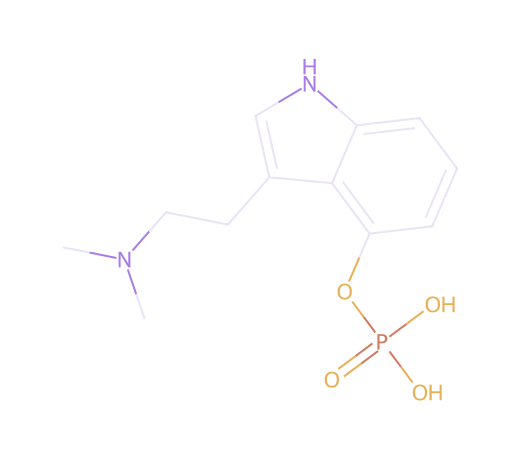
Psilocybin is the compound that makes certain mushrooms psychedelic, found mostly in species of the genus Psilocybe. Your body quickly converts it to psilocin, which is what actually crosses into the brain and does the work.
It is a tryptamine, the same broad family as DMT and the molecule your own body already makes. Of all the classics, it is the oldest companion: organic, emotional, and the one most people walk through the door with.
Flesh of the gods
Indigenous peoples of Mesoamerica used these mushrooms in healing and ceremony for thousands of years. The Aztecs called them teonanácatl, the flesh of the gods.
The modern Western story starts in 1955, when the mycologist R. Gordon Wasson sat in a mushroom ceremony with the Mazatec curandera María Sabina. His photo essay in Life magazine in 1957 put mushrooms in front of the world. A year later Albert Hofmann, the same chemist who made LSD, isolated and named psilocybin. The 1960s swept it into the counterculture and then into prohibition, and serious study only restarted at Johns Hopkins in the early 2000s.
Quieting the self
Psilocin's main action is at the 5-HT2A serotonin receptor, the same target the other classic psychedelics share. Modern imaging shows it turning down the default mode network, the system busy with self-talk and rumination.
That quieting tracks with the feelings people report most: the loosening of the ordinary self, the sense of connection, and at higher doses the dissolving of the line between you and everything else.
Earthy, emotional, alive
The come-up often arrives with the body first. A wave of yawning, a little nausea, a heaviness or a tingle, twenty to sixty minutes in.
Then the world softens and starts to move. Surfaces breathe, colors deepen, geometry creeps in at the edges, and emotion comes in waves you do not always choose. People describe being met by something, an intelligence in the experience. Mushrooms feel earthier and more feeling than the synthetics, closer to a forest than a thunderstorm.
The whole arc runs four to six hours, with a soft, often tender afterglow.
Where you land matters
Mushroom strength swings wildly, so these are ranges for dried Psilocybe cubensis, not guarantees. Tap a band to see it.
The full mushroom. Strong visuals, waves of emotion, the sense of being met by something. Earthy and raw.
The dose you can't see
Potency variability is the defining hazard. Two mushrooms of the same species can differ several times over, and chocolates or powders hide the dose entirely. Foraging adds a second danger: deadly look-alikes that no trip is worth.
Physically, psilocybin is non-toxic at normal doses. The risk lives in the mind: difficult trips are common enough to plan for, and they can leave a mark if no one is there to help.
Caution with a personal or family history of psychosis, schizophrenia, or bipolar disorder. SSRIs can blunt the effects, and combining with an MAOI, including ayahuasca, can be dangerous.
Start low, know the source
Three things carry most of the safety.
- Start low, especially with an unknown batch. You can always take more next time. You cannot un-eat what is already down.
- Favor whole dried mushrooms over powders and chocolates. Whole ones you can weigh and dose incrementally; a chocolate is a mystery you swallow whole. And never eat a wild mushroom without expert identification.
- Mind the set and setting. Mushrooms run emotional and earthy. A safe, familiar place and a sober person you trust are not extras here.
From the curandera to the clinic
María Sabina
The bridge from the old world to the new ran through one woman. María Sabina shared her ceremony with outsiders, and the attention that followed brought seekers, tourists, and trouble to her village. The mushrooms went global; she paid the price for it. The story is a quiet warning about what happens when the sacred meets the spotlight.
The mycology renaissance
The fascination never fully faded. Terence McKenna spun mushrooms into cosmology with ideas like the "stoned ape," more poetry than science but part of the legend. Paul Stamets pushed the science of fungi into the mainstream. And a wave of decriminalization, from Oregon to Colorado, has begun to pull the mushroom back out of the shadows.
Myth, separated from fact
Mushrooms are not addictive, and they will not rewrite your brain in a single night. They also will not hand you enlightenment on a plate. The honest middle is the interesting part: a powerful, non-toxic, deeply variable experience that rewards respect and punishes carelessness.
Most people come to mushrooms wanting the good without the hard. That is the pull of microdosing, and there is nothing wrong with it. But these pages are about the full dose. Not a heroic five grams, just enough to get past the sub-perceptual and come face to face with yourself. A gram and a half to two of something like Golden Teacher is plenty.
A full dose floods you. It puts you in front of yourself with nowhere to hide, and the days after are spent picking up what it showed you. That is the work, and it is what keeps a person honest. Which is why set and setting are not optional. A safe place, safe in the body and safe in the head, with water and music and a little fruit within reach.
The part nobody mentions is that it is a relationship. Not a pill swallowed once to fix everything, but a slow acquaintance with the mushroom that looks different for everyone. So know why you are walking in before you go. It is not escapism. It is the opposite: a step deeper into what is real, and a way of learning to like the person you find there.
Sources
- Davis et al. (2021). Psilocybin-Assisted Therapy for Major Depression. JAMA Psychiatry.
- Griffiths et al. (2006). Psilocybin and mystical-type experience. Psychopharmacology.
- Johns Hopkins Center for Psychedelic & Consciousness Research
- DanceSafe · Erowid — Psilocybin mushrooms